
This week some people are able to take a few days off work, school stops and the calendar marks Thanksgiving.
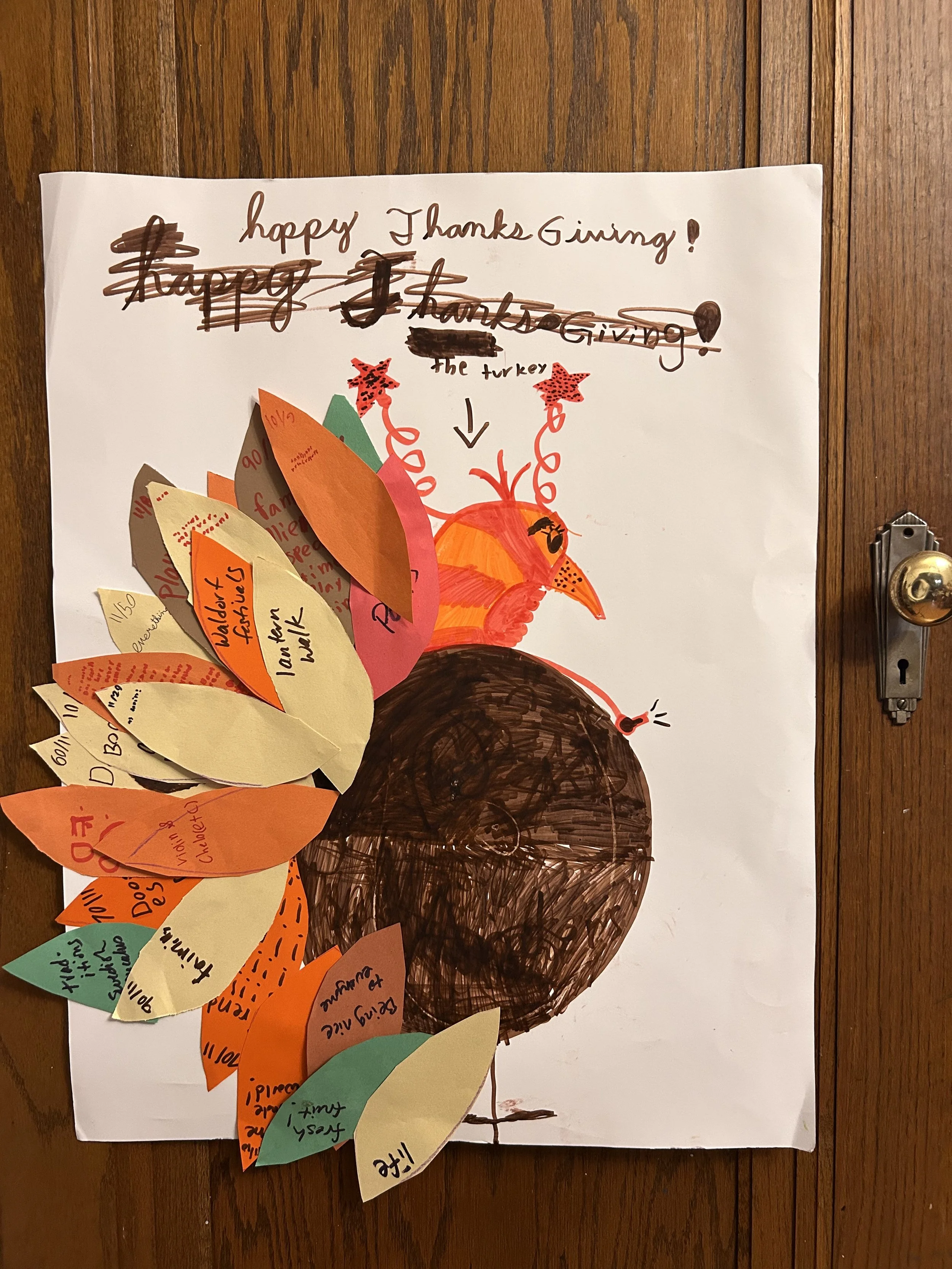
Two weeks ago, I started making a large paper turkey to which we would add feathers naming what we are grateful for. My daughter quickly took over, and when she finished, she proudly pointed out the whistle she’d drawn around its neck.
We live in Minneapolis. While it’s been quieter on the streets, nothing is forgotten. And my heart both broke and swelled with pride as she pointed it out. She knows many still don’t feel safe, and she knows we neighbor one another.
The turkey has been surprisingly generative for my kids. They remember to add a feather nearly every day, and my son calls it our “thankful turkey.”
My family will gather this week to share gratitudes and what we consider a traditional Thanksgiving meal. And yet, I’m struck by how much context matters.
For some, Thanksgiving is a painful day. The story many of us grew up learning about this holiday glosses over centuries of Native peoples’ experiences, histories and losses. I can hold gratitude for the opportunity to gather with my family while also acknowledging what this day represents for others.
And our own personal context changes from year to year. There may be an empty chair at the table, relationships that weigh on our hearts, or a particular tenderness in the ordinary moments with someone we know we won’t always have beside us. Sometimes gratitude and grief are so intertwined that it’s hard to name one without the other.
There’s room for all of this, and perhaps even room for a few additional feathers on our turkey. Grateful for what we’ve come to understand, for the people who have shaped our lives and for the opportunity to keep learning what we don’t know yet.
I didn’t always know what I know now. And once I did, it started mattering to me.
Context matters.
In college, I was invited home for Thanksgiving with a friend whose family is Italian-American. My friend’s mother generously welcomed me and an entire host of her family to her table. I recall delicious food, lots of people and a growing awkwardness inside me as the day went on.
Nearly everyone was talking on top of one another. Loud voices that edged on yelling, a lot of disagreement. It felt like a lot of family drama.
When I finally was alone with my friend, I quietly offered to go back to campus. Maybe I shouldn’t be there when there was so much going on with her family.
She was nonplussed. “What are you talking about? This is just how we are. No one’s mad, we just talk loud. It’s not real fighting.”
Baffled, I took her word for it. I did begin to notice that no one was walking away, there were no slammed doors, and there was more laughter than sharpness, even if it was still really loud (to me).
Years later, I learned about Intercultural Conflict Styles. Turns out I grew up in a culture that valued emotional restraint in conflict (act cool, calm and collected, stick to the facts and use minimal body language to show respect). My friend’s family valued emotional expressiveness (gestures welcome, big emotions aren’t necessarily threatening, and my willingness to engage passionately may be an indication of how invested I am in you and our relationship).
There’s nothing so practical as a good theory, and this one explained a lot for me about that Thanksgiving, as well as a myriad of other intercultural experiences over my lifetime.
What I had experienced as a rather uncomfortable family gathering was, for my friend, a perfectly lovely afternoon with people she loved.
I had understood what was happening through the lens of my own experience.
All these years later, I’m grateful that her mother made room for me at that table. I don’t imagine she had any idea how much I would carry away from that afternoon.
We all make sense of the world through the lens of our own experience. And we do it with far more than how loudly people talk around a dinner table.
As we enter this season of so many holidays, we’re likely to find ourselves in the company of people who do things differently than we do. How they show affection, contribute to a gathering, express gratitude, navigate disagreement or talk about what’s happening in our world.
We also arrive at these gatherings carrying things that others may know very little about. And given the political climate we’re living in, some of our differences may feel particularly hard to sit with this year.
So I invite you to notice: What differences make a difference to you?
When you feel yourself getting irritated, uncomfortable or even angry, can you get curious about what’s going on inside you? What expectation isn’t being met? What value feels threatened? What are you wishing were different?
And, when you have the capacity, can you extend some of that curiosity to the person across the table? What might be going on for them? What experiences, expectations or values are informing how they’re showing up?
Some things we might decide to let go of. Some differences might actually be an invitation to lean in and learn something. And some may call for us to speak up, set a boundary or excuse ourselves from a conversation.
Understanding someone’s context doesn’t require us to agree with them, excuse harmful behavior or abandon what matters deeply to us. But it can help us be more intentional about how we respond and where connection might still be possible.
I’m grateful for the people who have helped me see beyond my own context. And I’m grateful that, even after all these years of doing intercultural work, I still have plenty to learn. Sometimes from the people sitting around my very own dinner table.
I suspect our thankful turkey will have a few more feathers by the end of this week.
Whatever this season holds for you, I wish you moments of tenderness, curiosity and meaningful connection, and a little grace for all that you and those around you are carrying.