
Some things get clearer with time
This past weekend, I spent several days with some dear college friends sans kiddos.
(Huge shout out to my parents and neighbors who made it possible!)
We don't talk every week. We aren't up to date on every detail of one another's lives. But immediately, it felt like no time had passed.
There's something beautiful about friendships that have enough history to hold change. We aren't the same people we were at twenty. We've built careers, weathered disappointments, celebrated milestones, become parents (or not), cared for family, questioned assumptions, and grown into ourselves. Yet there's a trust that remains. A shared foundation that lets us pick right back up.
As I returned home, I realized that feeling has been showing up in another part of my life, too.
Over the past year, I've done a tremendous amount of reflecting, learning, experimenting, and rewriting. Some of you have watched that unfold in real time. There were moments when I knew I was changing but couldn't yet articulate exactly what I was changing toward.
Now I can.
I've completely rewritten my website, and more importantly, I've finally found the words for the work I've been doing all along.
Sparks of Change helps individuals and groups move through high stakes decisions, transitions, conflict, and growth with greater self awareness, resilience, and connection.
For individuals, my work has become especially focused on women navigating complex life decisions, whether that's becoming a solo parent, making a professional leap, moving through divorce, dating again, caring for aging parents, or another transition that asks, "Who do I want to be now?"
The methods may be coaching, facilitation, leadership development, intercultural learning, somatic practices, or spiritual guidance. But the heart of the work is helping people move through complexity with greater clarity, confidence, and purpose.
If you've ever wondered exactly what I do, I hope the new website makes that much clearer.
And if someone comes to mind as you read this, someone standing at one of life's crossroads, I'd be honored if you'd think of me or pass my name along.
One thing I continue to believe is that none of us navigates life's biggest transitions alone. We need people who remind us who we are, ask better questions than we ask ourselves, and help us move forward with intention.
My college friends reminded me of that this weekend.
These days, I feel something I haven't felt in quite a while: clear. Clear about my purpose. Clear about who I'm here to serve. Clear about the difference I hope to make.
If someone in your life is navigating one of life's big transitions, I'd be honored if you'd introduce us. And if you're simply curious about where Sparks of Change has evolved, I'd love for you to explore the new website.
Staying Grounded When You Go Counter Culture
It was both a privilege and, honestly, a surprisingly fun experience to be featured on Choosing Chaos: Solo Motherhood by Choice with Laura Nave.
Laura and I had a dynamic, down-to-earth conversation about cultural expectations, navigating reactions to having children without a partner, and staying grounded when your life choices don't fit someone else's idea of the "right" path.
It was profoundly meaningful to reflect on my personal journey to motherhood with the intercultural and developmental theories and skills that have shaped my professional life.
Together, we explored not only where other people's reactions come from when we make choices outside their cultural norms, but also how our own stories get activated. Most importantly, we talked about how we can stay in healthy relationship with ourselves and with others through it all.
If you've ever made a life decision that didn't fit the expected script, I think you'll find something here.
The episode is available on Spotify, Apple, Buzzsprout or your favorite platform.
Bumper Sticker Values
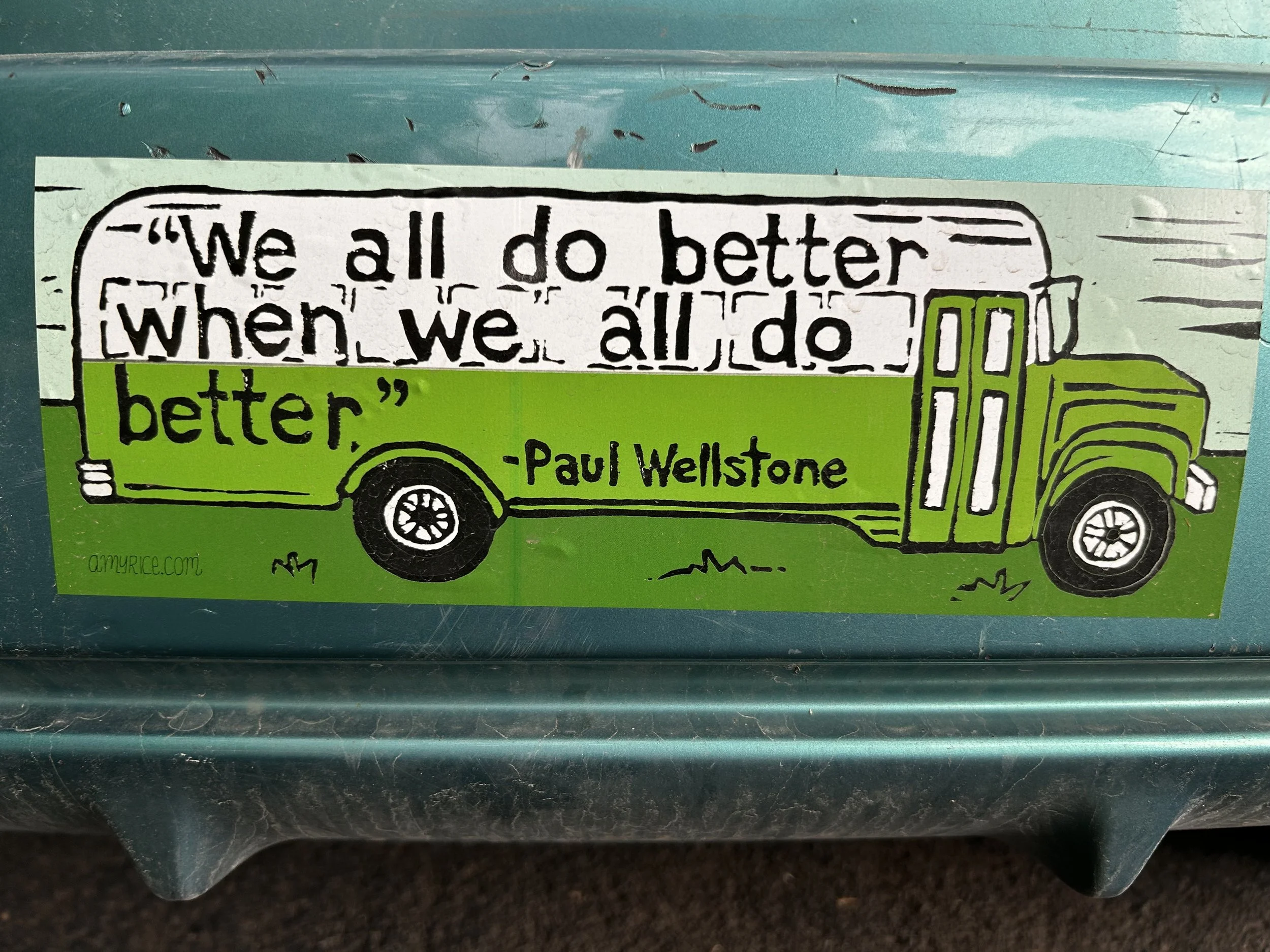
For the first time ever, I bought and actually adhered a bumper sticker to my car.
It's green, features a simple hand-drawn bus, and carries the Paul Wellstone quote: "We all do better when we all do better."
I've been reflecting on the past six months, and I think that early June purchase is actually the perfect capstone and motivator.
These past six months have been... a doozy? Dynamic? Tragic? Empowering? Unmoored?
All of this and more.
For the first time ever, I bought and actually adhered a bumper sticker to my car.
It's green, features a simple hand-drawn bus, and carries the Paul Wellstone quote: "We all do better when we all do better."
I've been reflecting on the past six months, and I think that early June purchase is actually the perfect capstone and motivator.
These past six months have been... a doozy? Dynamic? Tragic? Empowering? Unmoored?
All of this and more.
I started the year launching my new Sparks of Change blog with a burst of hope and vision. It had become clear that I needed to pivot my focus, and I was all in.
And then I found myself amidst the hardest physical and emotional winter we've had in years.
I grieved as my sense of national identity eroded, an assumed sense of security fell out from under me, and I felt a vulnerability for myself and my neighbors that was nearly overpowering. Bedtime dance parties became obligatory and were a saving grace, helping get the trauma out of my little family's bodies but we were all “in” something else entirely.
At the same time, friends and block groups led with courage, brilliance, and so much heart to build safety networks and defend human rights.
The both-and of it all was beautiful and hard.
In navigating this tumultuous context, my life purpose became even clearer to me.
The name Sparks of Change came to me years ago when I was in coach training. I just knew that my role would be to, well, spark change. To help others move through the muck, the shift, or the complexity and into greater alignment with themselves and their purpose.
I don't want to be the leader of the movement. I want to help you be the leader in your life.
And while that has always been internally clear, I've struggled with how to communicate it and connect with the right clients.
I actively practice holding paradox, so while I was applying for salaried positions that met strict criteria, I always knew Sparks of Change would live on. For a while, though, I wondered what form it would take.
Knowing that I needed to lean in and step into greater clarity with my work, I enrolled in an Akashic Records Business Mastery course from February through May. It helped me make some decisions and hone my messaging.
Months of work later, I've got an entirely redesigned website and full permission to myself to stake my claim:
Sparks of Change helps people move through high-stakes decisions, transitions, conflict, and growth with greater self-awareness, resilience, and connection. My group work is customized, highly experiential skill building. Individually, I help women wrestling with complex, life-changing decisions—like solo parenthood, taking a professional leap, or navigating major transitions such as divorce, dating again, or caring for aging parents. Through customized 1:1 coaching, group trainings or facilitation, you will develop the skillset and mindset to move forward with clarity, confidence and purpose.
THIS.
This is the biggest shift of the past six months.
It's feeling rooted in a solid knowing that all the skills and experiences I've acquired can be blended in service of your growth and freedom and our collective good.
While it's uncomfortable and scary to have institutions crumbling and established ways of being disrupted, there is also tremendous opportunity to do things differently right now. To create lives, relationships, organizations, and communities that work better for more people.
We start with ourselves.
We take that into our relationships, our families, our workplaces, and our communities.
And slowly, together, we lift the collective.
"We all do better when we all do better."
Thanks, Paul.
I'm all in.
Notice the Magic
Joayne’s Guide to Stay Sane, Chapter 6
Notice the Magic & Feed the Beauty
Let’s take a breath together.
A soft inhale.
A longer, easier exhale.
This final chapter is about something simple — almost disarmingly simple — and yet profoundly regulating for the nervous system:
Noticing the magic. Feeding the beauty.
Years ago, my brother came up with this wonderfully quirky idea: we’d call each other once a day and share exactly one moment of beauty. No updates, no debriefing, no long story arcs. Just a single snapshot of something that made our hearts lift.
It usually went something like this:
Him: “Hey, you got a second?”
Me: “Always. What’s your moment today?”
Him: “I’m watching first graders try to catch leaves on this windy sidewalk. It’s chaos and joy.”
Me: “Ahh… okay. Mine was the frost glittering on the railings during my walk to the train. Tiny ice crystals, like nature’s confetti.”
Then:
“Beautiful. Love you. Talk tomorrow.”
And that was it.
Short.
Sweet.
Deeply meaningful.
And honestly? It did so much for both of us.
Why Noticing Beauty Matters
It strengthened our connection without requiring long emotional labor.
It trained our attention toward delight.
It pulled us out of autopilot and into presence.
And — as I talked about in Chapter 3 on Gratitude — when we intentionally name what’s beautiful, it raises our vibration, bolsters resilience, and rebalances our nervous system in subtle but powerful ways.
When You Notice Magic, You Get More Magic
Something shifts internally when you choose to pay attention to what is good, gorgeous, funny, quirky, or awe-inspiring.
It’s as if your inner compass gets recalibrated toward hope.
The world doesn’t get any less complicated — but you become more resourced.
And this chapter, perhaps more than any other, is about resourcing yourself through the smallest possible portal.
But… How Do You Make This a Habit?
You’re right — life is already full.
You don’t need one more task, one more list, one more “should.”
So here’s the gift of this practice:
You can tuck it into something you’re already doing.
James Clear popularized this in Atomic Habits — habit stacking.
If you attach a small, meaningful habit onto something that already happens daily, the new habit becomes almost effortless.
Try pairing your “moment of beauty” with:
· brushing your teeth
· waiting for the microwave
· washing your hands
· your first sip of coffee
· turning off your bedside lamp at night
The practice isn’t about being profound.
It’s about being present.
Try it for five days.
Just five.
And watch what happens.
Try It Right Now
Pause.
Look around.
Or look back on your morning.
What caught your heart?
A color? A face? A sound? A moment of stillness?
Hold it for a breath.
Then — if you’re willing — share it here with others who are practicing the same gentle magic via this shared framapad.
Your moment might be the reminder someone else needs today.
Closing the Guide: Your Invitation
This is the final chapter of this series — but it’s not the end of your practice.
If Chapter 1 taught you to know yourself…
If Chapter 2 helped you be with discomfort…
If Chapter 3 lifted you through gratitude…
If Chapter 4 invited you into repair…
If Chapter 5 encouraged you to face the sun…
Then Chapter 6 is the tender thread that weaves them all together:
Notice what’s beautiful, and your soul will remember how to rise.
Thank you for walking this journey with me — breath by breath, chapter by chapter.
If you want support integrating any part of this guide into your life or relationships, I would love to connect. This is the work I do every day with clients who want practical tools, deeper resilience, and more soul-aligned living. I
If these chapters have stirred something in you, you are invited to:
· book a conversation with me
· explore Akashic healing or coaching
· or simply reply and share your own moment of beauty here.
You deserve support.
You deserve connection.
And you deserve a life with more magic in it.
With warmth and gratitude,
Joayne
Face to the Sun
Joayne’s Guide to Stay Sane, Chapter 5
How Naming Your Desires Nourishes Your Soul
Winter in the northland has a rhythm all its own. Some days, it’s “cloud city” — long stretches without direct sunlight, we are back to the regular vitamin D supplements! And some days, lucky for me in the past few weeks, the natural world feels like a snow globe: big, fat crystal flakes drifting slowly, beautifully, covering everything in soft white powder.
This contrast had me wondering:
If vitamin D nourishes my body… what nourishes my soul?
What’s the inner version of sunlight — especially in seasons that feel cloudy, uncertain, or heavy?
One of my guiding values surfaced immediately:
Put your face to the sun.
This phrase came from two beloved colleagues who held me during a particularly dark time. It became a spiritual practice, a grounding principle, and a reminder that I could still choose warmth, vision, and desire even when the path felt murky.
Today, I want to share what this value means — and how it can help you reconnect to hope, desire, and possibility, no matter what season you’re in.
What Does It Mean to “Put Your Face to the Sun”?
At its core, this practice is about courageously naming what you want.
Not the version you think you should want.
Not the smaller, “safer,” more reasonable desire you’ve talked yourself into.
But the honest, heart-level desire that lights you up.
This is your soul’s vitamin D.
It brings:
clarity
direction
expansion
emotional warmth
connection
possibility
When you turn toward your desire, you turn toward life.
First, Lay the Groundwork (A Quick Review)
This chapter builds on the earlier steps:
1. Know Your Values (Chapter 1)
Values act like trail markers — they keep you oriented even in a dense forest.
2. Be With the Discomfort (Chapter 2)
Feelings can exist without steering your choices.
3. Cultivate Gratitude (Chapter 3)
Gratitude lifts your vibration and pulls you toward hope.
4. Reach Out for Repair (Chapter 4)
Tend to your relational field with self and others.
These four practices create the inner stability you need to name your desires without collapsing into fear, shame, or scarcity.
The Brave Work of Naming What You Want
Naming your desire is vulnerable — especially when:
you don’t know the how
it feels too big
it feels “selfish”
you’ve been disappointed before
you’re tired or in a difficult season
But desire is powerful.
It’s direction.
It’s vitality.
And it’s deeply human.
There is a quiet, fierce bravery in saying:
I’m allowed to want things.
I’m allowed to speak them out loud.
I’m allowed to be supported as they unfold.
When you “put your face to the sun,” you open the door to alignment, creativity, and abundance. You also allow the universe — and the people who care about you — to meet you halfway.
We forget this, but it’s true:
People genuinely love to help bring dreams to life.
Happiness begets happiness.
Abundance begets abundance.
A Gentle Practice: Turning Toward the Light
Find a quiet moment.
Place a hand on your heart or belly.
Take a slow inhale… and a longer exhale.
Then ask yourself:
What do I truly desire right now — without minimizing it?
What would “face to the sun” look like in this moment?
Who could help me — if I allowed myself to be supported?
What small step would honor this desire today?
Let the answers rise slowly.
Let them be imperfect.
Let them be yours.
And then — turn toward the light.
Reach Out for Repair
Joayne’s Guide to stay sane, Chapter 4
How Learning to Repair — Inside Yourself and With Others — Helps You Stay Grounded, Connected, and Whole
For a long time, life felt pretty smooth for me.
Good friends. Interesting opportunities. Enough ease that I was happy. The one thing I longed for was a deeply loving partnership — and I had to wait until my late 30s to find that.
When I did, I thought I was finally set.
And truthfully, so much of it was beautiful: ordinary moments, small joys, and the comfort of building a life with someone.
But there was another side — moments of anger, misunderstanding, misalignment, chronic conflict. It took me a long while to appreciate those harder pieces. I’m grateful for them now, because living our differences so intimately was what propelled me into the work I do today. When I look at this entire “Guide to Stay Sane,” I can see that almost every insight emerged — directly or indirectly — through that relationship.
We eventually dissolved our marriage, but the learning (and the love) continues to shape me. And the greatest wisdom from that chapter was this:
Staying sane requires learning to repair.
Internally.
Interpersonally.
Again and again.
Conflict isn’t a detour; it’s part of the human curriculum.
Why Repair Matters (and Why It’s Harder Than It Looks)
A mentor once told me:
“Going through difficulty together can bring people closer”
Repair is what prevents small ruptures from becoming long-term distance.
It’s what keeps us connected through stress, uncertainty, and difference.
It’s how we grow individually and relationally — not in spite of conflict, but through it.
And yes, repair is vulnerable. It asks us to soften when our system wants to armor up.
But it’s also one of the most life-giving, sanity-saving practices we have.
Your Foundation: Chapters 1–3
By now, you’ve gathered a toolkit:
Know your values
Be with discomfort
Practice gratitude to stay resourced
These aren’t just “nice ideas.”
They are the scaffolding that makes repair possible.
How to Reach Out for Repair (Without Losing Yourself)
Here is the practice as it lives in my real life — messy, imperfect, human:
1. Practice Humility
Ask yourself:
What might I not know?
What else could be true?
What values of mine are activated?
What values of theirs might be activated?
Humility softens defensiveness.
2. Vent Your Intent (somewhere safe)
Your frustration gets to exist — it just shouldn’t be the driver when you seek repair.
Talk to a neutral person. Journal. Voice note it.
Let the emotional static clear so connection has space.
3. Lean Into Vulnerability (with practicality)
Repair doesn’t require heroics.
Just ask:
What’s one step toward repair?
What internal support do I need to take it?
What will help me feel safe enough to reach out?
Small is enough.
4. Focus on Impact (not just intention)
You can have the best intentions in the world — but repair happens at the level of impact.
This isn’t about blaming yourself.
It’s about acknowledging the other person’s experience matters.
When we listen with openness, things shift.
5. Gather Internal and External Resources
Repair takes capacity. Support yourself with:
somatic grounding
breathwork
tapping
sleep
rest
emotional support
community
professional guidance, if needed
We repair better when we’re resourced.
The Heart of Chapter 4
If Chapters 1–3 help you understand yourself and hold steady inside uncertainty…
Chapter 4 is about staying connected while you do.
Repairing what’s frayed — in yourself and in your relationships — is how we:
protect our nervous systems
preserve important connections
grow in resilience
and stay sane in a chaotic world
Repair is relational hygiene.
It’s emotional maturity.
It’s what makes love — in all its forms — sustainable.
A Question to Begin Your Own Repair Practice
Before you decide what to do next, ask:
“What would support repair here — for me, and for us?”
That question alone opens the door.
A Gentle Invitation
If you’re navigating something tender — conflict, disconnection, stuckness, or even repair with yourself — you don’t need to figure it out alone.
This is the work I love: helping people understand their patterns, steady their system, and reconnect with what matters most.
Reach out if you want support, tools, or a clearer map for what comes next.
There is always a path back to connection.
Cultivate Gratitude
Joayne’s Guide to stay sane, Chapter 3
The Power of Gratitude: How Daily Noticing Strengthens Your Resilience, Mood & Health
When I turned 40, I started a ritual:
40 days of gratitude.
Every year since, I’ve added a day to match the number I’m turning. I begin a few weeks before my birthday and continue a few weeks after — a cozy little gratitude sandwich.
And each year, something shifts:
my vibration lifts
my emotional resilience expands
the world feels a bit more generous
I feel more connected — to life, to Spirit, to myself
And people love reading the posts. Because gratitude is contagious. When we share it, we elevate each other.
Why Gratitude Works (Backed by Research*)
Studies in psychology and neuroscience show that practicing gratitude consistently can:
increase positive emotions
reduce symptoms of anxiety and depression
improve sleep
enhance empathy and reduce reactivity
strengthen mental resilience
boost overall wellbeing
Gratitude is not spiritual fluff.
It’s a proven wellbeing strategy with real physiological impact.
How to Practice Specific, High-Impact Gratitude
Vague gratitude (“I’m grateful for my family”) is lovely — but specific gratitude is where the magic happens.
Here are some prompts backed by positive psychology:
In the last month, what is something someone did (big or small) that you’re grateful for?
What did you get to do that you’re grateful for?
What is something someone said that warmed you?
What are three things in your local environment or nature that bring you joy?
What simple pleasure delighted you recently?
What have you learned this month that you’re grateful for?
What are three qualities in yourself that you appreciate?
What’s something you ate this week that really hit the spot?
Specificity builds presence.
Presence builds resilience.
Why Sharing Gratitude Amplifies the Benefits
Research also shows that expressing gratitude — not just feeling it internally — creates a ripple effect:
deeper social connection
increased empathy
stronger relationships
a measurable increase in happiness (for both people!)
If you want to explore that research, here’s a great article from The New York Times “How to Turn Your Gratitude Into a Habit”
A Gratitude worksheet You Can Use Today
I created a simple, friendly template to make this easy:
👉 Download the Spark Your Gratitude Refletion
Or book a session if you want support weaving gratitude into your daily life in a grounded, sustainable way.
Let Gratitude Hold You Through the Season
Gratitude won’t eliminate the hard things.
But it softens the ground beneath your feet
and steadies your heart
so you can move with more grace and hope.
*Sources: https://pmc.ncbi.nlm.nih.gov/articles/PMC10393216/ and https://www.psychologytoday.com/us/blog/what-mentally-strong-people-dont-do/201504/7-scientifically-proven-benefits-of-gratitude
Be With It (all!)
Joayne’s Guide to stay sane, Chapter 2
How to Sit With Discomfort, Fear, and Uncertainty (Without Letting Them Run the Show)
What’s the thing you cannot be with?
Back in 2014—right in the middle of my coach training and a particularly dynamic (read: tumultuous) season of my life—I was asked a question that stopped me in my tracks:
“What’s the thing you cannot be with?”
Strange grammar. Powerful insight.
My honest answer (after some soul searching and raw feedback from friends):
I don’t like being wrong.
Not the small mistakes — those I can own.
But the big relational misses? The conflicts? The moments when my internal standards felt unmet?
Those hollowed me out.
And, over time, I learned something essential:
Your “thing you can’t be with” will run your life if you don’t learn how to sit with it.
Why Sitting With Discomfort Matters
Emotional discomfort is part of being human. And when we resist it, suppress it, or outrun it, the pressure builds.
Psychologists call this experiential avoidance — when avoiding a feeling creates more suffering than the feeling itself.
The truth is:
You can feel fear and still act from wisdom.
You can acknowledge discomfort without letting it hijack your decisions.
You can hold uncertainty and stay grounded.
This is the heart of emotional regulation and conscious leadership.
Two Tools That Help You “Be With It”
1. Seat Fear in the Back (Elizabeth Gilbert’s Big Magic Metaphor)
In Big Magic, Elizabeth Gilbert writes that she expects fear to show up every time she creates. She even speaks directly to it, here’s my paraphrase of her brilliance:
“You can come along for the ride.
You can share your opinion on music choice.
But you do not get to touch the controls.”
Fear exists… but it doesn’t get to rule the airwaves.
This metaphor changed me.
2. “What You Resist Persists.”
A two-part mantra from my Co-Active coach training:
What you resist, persists.
Face your fear and watch it disappear.
Disappear not as in “gone forever,” but soften— become workable, understandable, maybe even humorous.
Allowing what’s true is often the doorway to choosing what’s next.
A World That Requires Emotional Resilience
We’re living in a time that is tender, disorienting, and wildly uncertain. A true VUCA world — volatile, uncertain, complex, ambiguous.
If you want more context, I wrote about it here.
Learning to be with your inner world is becoming a leadership competency, a spiritual practice, and a mental health strategy all at once.
A Tool to Help You Take Stock (Free Download)
I created a simple, grounding Check-In Worksheet that offers you a gentle way to take stock, ventilate what’s swirling, and reconnect with your center so you can see your way forward.
👉 Download the WWW Check-In Worksheet
Or book a session if you want support learning how to apply it in your day-to-day life.
Let This Be a Gentle Invitation
Naming the thing you “cannot be with” is powerful work.
Learning to let it ride in the backseat? Even more so.
If you want support, reflection, or a co-regulating presence, I’d love to walk with you.
Your inner world deserves care.
Your nervous system deserves space to breathe.
And you don’t have to do any of this alone.
Know Your Value(s)
Joayne’s Guide to stay sane, Chapter 1
Identify Your Core Values: The Foundation of Emotional Resilience & Aligned Living
Your core personal values shape every decision you make, guide your relationships, and influence your emotional wellbeing — often without you realizing it. When you know your values clearly, you move through the world with more intention, confidence, and inner steadiness.
Why Personal Values Matter (More Than You Think)
Indulge me with a hiking metaphor.
Think of those paint blazes on a trail as your values. In the thick forest, when the path curves and you’re not totally sure where to go, those markers guide you forward. That’s exactly what your values do when life feels complicated or emotionally dense: they orient you back to integrity and aligned choices.
Research in positive psychology shows that people who consciously identify and act on their values experience:
greater emotional resilience
lower levels of stress
clearer decision-making
stronger, more connected relationships
Your values are not abstract ideals. They’re your internal compass.
How Misaligned Values Show Up in the Body
And when your values aren’t honored?
They rub — like a blister starting in your boot. First, it’s a small hotspot, a tiny “something feels off.” If ignored, it becomes a burn, and eventually it slows you down or pushes you toward a reaction you don’t love.
Your body often knows before your mind does. It can feel like:
tension, anger, or irritability
internal conflict
“hot spots” of stress or resentment
fatigue or heaviness
So before you begin any “hike,” check in with yourself:
• What matters most to me right now?
• What’s my goal in this moment or relationship?
• And if something starts to rub, how will I respond with care?
A Personal Example: “Work Toward a Yes”
Years ago, with a powerful relationship coach, I did an activity to flesh out my core values. One of my enduring favorites: Work toward a yes.
So last summer, when my 8-year-old asked to eat dinner on the front steps instead of the table, my reflexive “no” softened. Living my value meant:
pausing
listening
asking a couple gentle questions
noticing: Is “no” really necessary here?
And the moment transformed.
She felt heard, and I stayed aligned with myself. Everyone wins.
This is values work in real life — simple, imperfect, human.
The values development activity was powerful enough that I built a simple template for you.
Download it here.
And — because I know myself — as an extrovert, I’m so much more likely to follow through when I do this kind of reflection with someone else. If that’s you too, book a session with me and we’ll walk through it together.
Joayne’s Guide to Stay Sane
Yowza. This life — this one amazing, messy, dynamic life — I’m deeply grateful for it, and also… some parts lately? Not my favorite. These past few years have been hard. This past year, almost beyond words. And right now? New levels of “a lot” to put it mildly.
As I look back at this year, I have been holding a dual reality: beautiful moments and things mostly working out for my little household and witnessing unprecedented (and unwanted to me) changes and pain for neighbors such that it’s been a constant dance with the unknown, feeling unsure, and still choosing to move forward.
Then, about a month ago, eating a bite of French silk pie on an ordinary Tuesday, something shifted. I felt myself rise just a little above the muck — a clearer curiosity, a stronger faith. And I’m genuinely excited for what’s next.
You’ve been with me for a long time, reading these reflections and walking this path in your own way. I want to honor that and thank you.
A few updates from my world:
• I’m launching something brand new: Joayne’s Guide to Stay Sane.
A six-part series with:
– bite-sized reflections to support you right now through the new year
– practices you can do in under 4 minutes
• I started this blog.
A home for selected past reflections and an easy archive to share. You’ll find pieces from the archive like:
– It’s a VUCA world
– Should DEI die?
– How do we hold this?
– and a timely oldie from 2020…
• My individual services will be getting a refresh — and prices will rise in February.
Sneak peek: Chapter 1 includes a free downloadable activity you can use solo, with a partner, your family, or your team.
How do you let go?
Autumn always reminds me that nature doesn’t cling. Trees don’t negotiate with their leaves — they simply let go. 🍁
And in doing so, they make space for what’s next.
This is a powerful time for us to do the same.
As the light softens and the pace of summer fades, our bodies and spirits crave a clearing — a chance to release what’s been heavy, to compost the old patterns, and to prepare the soil for something new.
Maybe you’ve noticed what’s asking to fall away:
• An old story you keep replaying.
• A relationship dynamic that drains you.
• A pattern of self-doubt or overdoing that no longer serves you.
You don’t have to carry it into the next season.
In an Akashic Healing Session, we can uncover the deeper story behind what’s keeping you stuck — and help you release it with clarity and grace. Together, we’ll invite in freedom, calm, and the kind of inner spaciousness that lets new growth take root.
If your soul has been whispering “it’s time,” this is the perfect season to listen.
From an 8 to a 2
The world keeps asking us to be flexible and resilient—and you’re doing your best. Some days (or moments!) our “best” feels strong, other times it’s harder. I’ve been leaning on the people who fill my cup and keep me grounded.
Who does that for you? Family, friends, healers, authors?
Here’s a quick story:
A first-time client came in still hurting over a hiring process that ended badly. She’d done so much inner work, yet seeing the person involved still triggered her. We opened her Akashic Records, uncovered the soul lessons at play on both sides, and used simple tapping to release the emotions.
By the end of the hour, her pain dropped from an “8” to a “2.” A week later, she wrote to say she’d even had coffee with the person she once dreaded seeing.
Your soul is always reaching for love and repair—sometimes our human selves just need a little help finding the path.
Come do an intuitive healing session with me. You don’t have to know exactly what to address—it will become clear once we begin.
How do we hold this?
Uff da.
That’s my cultural (Scandinavian immigrant) utterance for Oy Vey, Ay Caramba, Shiiiiiiiiiiiiiiiit.
What we are living is not what we have been living.
I don’t think it will ever be the same again.
I grieve the loss of pride and safety in my national identity.
I wonder how to raise kids in a context that is shifting and will be nothing like the stable ground I grew up in.
My mind gets overwhelmed alternately trying to take in or shut out the news.
My heart vacillates between feeling sadness for how humans are treating other humans and the pure innocence and comic relief of my 3 year old “So, Mom, is chocolate made of chocolate chips?” as he snacks on a few in the back seat.
And around all that, I still have to cook dinner and plan the weekend.
I keep asking myself: How do I hold this? Is it ok to shut something out? How do I see and not let it crush me?
When I wallow in despair or list all the horrible things again (and again) it’s unhelpful for my mood and ability to show up as mother, neighbor, friend. And a total blinders approach feels heartless and wrong as well.
So, what’s the alternative? How do we hold the duality? Big picture chaos and being present to delightful moments? Monumental shifts in policy and precedents with mundane choices and picnic suppers at the lake while the sun shines late?
I don’t know but I’m trying. I think the key is something like really caring for my inner self. Connecting and rooting into my awareness of my body even if it's just a mind exercise at first. Keep visualizing a connection to the Earth, the Divine/Creator/Source and just say that I choose to ignore dread and focus first on love and faith.
The idea of spheres of control continues to help me, too; all I can do is control that inner most circle…although even control seems lofty to say. Perhaps it’s more CURATE. What can I curate within myself?
I can:
take care to nurture certain thoughts
amplify the love for those around me by seeing it, naming it and sharing it out loud
search for humanity and that of God (as the Quakers say) in others
choose calm and breathing rather than catastrophe and doomscrolling.
And you?
What can you curate within your own inner sphere?
I want to believe that all this breaking leads to a new creation. That it’s revealing stuff we need to see so that we can change from the roots.
I try to hold that.
And uff da. That takes a lot of energy and mind-training. I’m using willpower all over the place and it’s a lot. It is hard to hold this complexity and to curate within.
How is it going for you? What are the unique set of variables in your life that make a difference in how you hold this all?
Should DEI Die?
Should DEI just die?
Conceptually, no. Never! We will always need to acknowledge differences and take measures for the outcomes we want.
Differences will always exist. Thank heavens! (Despite occasionally being tempted by the idea, I do know that nobody would be served by a world full of clones of myself.)
The old adage that two heads are better than one turns out to be evidence-based. However, there is an important caveat: it's true when each head, or team member, is valued for their differences and feels included diverse teams outperform homogenous teams.*
Should DEI just die?
Conceptually, no. Never! We will always need to acknowledge differences and take measures for the outcomes we want.
Differences will always exist. Thank heavens! (Despite occasionally being tempted by the idea, I do know that nobody would be served by a world full of clones of myself.)
The old adage that two heads are better than one turns out to be evidence-based. However, there is an important caveat: it's true when each head, or team member, is valued for their differences and feels included diverse teams outperform homogenous teams.*
If we don’t have inclusion, we don’t get optimal results from teams whose members have different identities, thinking styles, life experiences, ways of being, etc. Which is pretty much any team or even pair of humans.
But should we ix-nay the acronym-ay?
Honestly, for a few years I have felt that the shorthand was beginning to lose meaning and risked becoming a performative set of letters. I’ll bet most of our workplaces have their own alphabet soup of acronyms. They are handy and most of the time they refer to concrete processes or manuals or departmental work teams. Diversity, Equity and Inclusion practices and beliefs are incredibly multifaceted and encompass people, practices, feelings, outcomes and more. They are inherently complex and context dependent. It is rather a disservice to relegate these principles that get to the core of our values and hearts as humans to an acronym. And then if teams fail to develop shared understanding on what the acronym means in practice, both the definitions of the words but also how they are conceptualized into practice, people fall into assumptions. And sadly, some approaches have evoked shame rather than mutual learning and thus we are living a time when the acronym is being weaponized.
“A rose by any other name would smell as sweet.” William Shakespeare
It doesn’t matter how we call it. Our hearts still yearn to connect across differences. And yowza what a set of differences we are dealing with right now!
I’m still doing and will always be doing intercultural competence work because that is the core of any and every human interaction.
So we lose the acronym. The work by any other name is just as powerful and needed. I came to this work from international development, my own overseas experiences and a deep set of differences within my most intimate relationship that caused us a lot of pain. Thus, the intercultural competence approach has always resonated as the strongest way to achieve DEI outcomes.
I do believe words matter. And in this case, words matter less than shared meaning. I will always stand for and support people to learn and develop mindsets and skillsets around diversity, equity and inclusion.
Over the past two years I was called to consider my professional evolution and the umbrella idea that emerged is connection. And when I get down to it, that manifests as three forms of connection to and with:
Self
Others
Spirit/Source/Creator
The essence of intercultural competence is developing skills and awareness in three domains that can be shorthanded as Self-Other-Bridge. (With gratitude to colleagues and mentors who have honed language through years of work and deep discussions working across differences.) This simply means helping people see their way of being, be curious (and have appropriate tools and resources to inquire and learn about others), and strategies to reach across and build connections when there are differences that make a difference.
What does this mean for Sparks of Change?
I’m still here!! I am still coaching individuals and facilitating teams and groups. We still feel the call for growth to be even better than we already are. I am booking teams for the fall who are ready to be even better than they already are, eager to not only raise their awareness but leverage and adapt to differences to get the results they want. (In ways that feel good to all.)
Also, in coming weeks you’ll see I’m really building out my offerings as a healer and coach for any sphere of your life but most particularly for those relationships that are most dear- parent, child, partner. Finding ease and insights for our most cherished relationships helps everyone around us.
Given the landscape we are living, we all need to ensure we take care of ourselves so that we can be of service to the collective.
It’s a VUCA world
It all begins with an idea.
I never expected to be self-employed and am continually gratified to be of service and earn a living as a coach, healer and facilitator.
I also hadn't imagined the vulnerability and polarization we are experiencing as a country. Is anyone else grieving? My national identity, my sense of what to expect...the loss of how I thought things would always be...it's all up in the air.
It’s VUCA: Volatile, Uncertain, Complex, Ambiguous*
Beyond my internal reflections, friends and colleagues are jobless, programs defunded, and the news continues to be challenging. The ripple effects go on as we navigate unexpected trauma alongside cooking dinner, mitigating sibling rivalry, plan logistics and care for our loved ones.
It’s a lot.
And looks like it will be this way for a while.
[Insert big belly breath here. Repeat. Ok, now read on.]
Given all that VUCAness, what is within our control?
Ourselves. How we care for ourselves and for one another. How we manage our relationships. How we invest, show up and serve.
Marketing myself always feels a bit tricky as I have some deeply embedded values around humility from my rural North Dakota Scandinavian culture to not stick out or be boastful.
And…the context has shifted. We need one another's talents and skills in complementary ways to bring us through.
There's a trend in my healing sessions–when given the chance, nearly everyone asks for insights about a close relationship, usually parent or child.
The results are always astounding. The client tells me the person’s name, I tune in and something comes through. It’s usually an image or a metaphor “Seems like you are walking parallel but the other person leans on you more for X, but they also support you in such and such” or “You’re like two playful dolphins that have solo adventures but always come home to one another” or “Your child is light, full of air, almost as if holding onto a helium balloon.” And sometimes it's "You are tied but there's an imbalance in what you receive and the reason seems to be XYZ and here's how you can reframe that and mitigate the pain for yourself."
And that’s just the beginning! We dive in from there to ask how you can nurture, repair, or ask for a shift in that relationship.
It’s transformational. Supportive. Healing. Liberating!
I speak from experience. I came to this kind of healing as I sought resources for my own kids. It started with a cranial sacral therapist who could sense messages from my baby and released birth trauma from her body. It grew into people who could explain certain dynamics and suggest approaches that honor the soul work I have with my kids. It has helped immensely to have images and ideas of what’s going on energetically that I can then work on in my daily interactions. And I’ve gotten my own healing along the way.
Explore Generational Soul Support
Generational Soul Support is designed for you to learn about yourself and your relationship patterns, quirks, soul work with others. In particular your kids or your parent(s) figures.
Self care? Ugh or…?
It all begins with an idea.
Be honest, does the "put on your own oxygen mask first" idea compel you to invest time in yourself?
Or does it make you kinda roll your eyes because it's a lovely thought but...impossible to execute?
I nod my head, I tell it to others and when it comes down to it---I put others first.
So here's a thought--
What if it's more than self care?
So, what if it's not just about you? What if others actually need you at your best?
When we do a session, you get insights, healing releases and support that will transform you instantly and wait for it--- positively improve your relationships with others.
When you feel better, you show up better, you are more in tune and thus you can serve others more deeply.
Better yet- - - What if there's a "both and?"
There is! What if you can get self-care while you are getting tips and insights on how to serve those you typically put first? For example, with your kids? With your parent? With another loved or not-so-loved-but-inherently-in-your-life one?
You can.
You can because I can. I do that now. In 50 minutes, I'll describe the nature and dynamics of your soul contract, what that means for your relationship and give you ideas on what will support you both. Along the way we'll tend to any healing and releases that are in your highest good and, I guarantee, you'll feel lighter, more equipped and deeply held in love by the end of our session.
It's better experienced than explained. Just try it.
What makes a country happy?
A while back, I asked you: Given the upheaval and uncertainty of this time, what’s in your control?
The world continues to be in flux.
Living this tension of uncertainty alongside excitement for the good that still exists takes energy.
To keep seeing joy when there is much to protect is a big ask.
I always tell you to breathe, so take a moment and do that. Keep doing that. Set reminders to help you do it intentionally and deeply. The Japanese say you need 36 deep breaths a day. Thirty-six. Challenge offered, standard set, will you accept?
And, today I want to highlight another strategy: Connection.
I recently rebranded with a new logo and website because I realized the central tenet of all my work is facilitating connection.
Connection to self. Connection to Other. Connection to Spirit.*
This made intuitive sense to me and then last week, I read “The Happiest Country in the World Isn’t What You Think” by the researchers leading the Global Flourishing Study.** They are examining several domains of wellbeing over five years, and the first year has revealed that people flourish when they feel—wait for it--
Connected to their own meaning
Rich in relationships, and
Deeply tied to a community
BOOM. There it is. Connection.
A while back, I asked you: Given the upheaval and uncertainty of this time, what’s in your control?
My answer is:
Your relationship with yourself.
Your relationships with those around you.
Your relationship with a higher power.
So, let’s get practical. How do we support ourselves through this muck?
The data-driven answer is: Invest in your relationships. Develop deeper community. Connect.
If that feels easier said than done, then book a call with me now.
Because I can tap into your intuition with you, we can examine relationships and identify what they need.
You can and should have a relationship with your Higher Self and that of God/Creator/Source within in you. Everything I do is co-creation and we’ll get you whatever you need in the moment.
*Otherwise known as Source, God, Universe, the Divine, however you want to name that force that is beyond ourselves
*You can find the Global Flourishing Project and data here: https://www.cos.io/gfs
A helpful tool from 2020
Note: first published April 2020. There seem to be a few lessons here and thus it’s worth publishing. We made it through what was unfathomable. The shifting uncertainties just kept coming (ahem, still relevant?) and the WWW Check in takes but a moment and yields such insights, it’s a free uplift for ourselves!
Hmmm…
How do I even write an opening line to you? In an upside-down world where nothing is like it was – with most of these changes forced upon us —opening small talk and a gentle entry into conversation seems either trite or impossible.
So let me just acknowledge that. And you.
You are doing a tremendous job right now. I know this to be true—whether you’re working the front lines (huge thank you as I cannot even comprehend what you are facing), working from home in unexpected isolation or with too many “coworkers” while you learn the ropes of homeschooling or not suddenly not working and managing the uncertainty that entails.
This was not planned. This has thrown a wrench in your routine. This has waylaid fun plans and activities that renew and inspire you. This has added duties and burdens in ways you never dreamed possible and certainly aren’t in your wheelhouse. It has led to grief not only for things but also for people as we bear witness to those near and far who have fallen victim to the pandemic.
And yet, I know that you are still here. Still waking up and making it through the day, caring for your loved ones, supporting your mission at work or home and adapting to every twist and turn that comes your way.
Whatever you are facing, you are doing it and doing it to the best of your ability. And you need to pause and honor that for yourself.
This is where the little gremlin in your head might say something like “Yeah, right, I’m failing all over the place.” “They are doing it perfectly, just look at their facebook posts of family fun.” “You’re not doing anything special, we are all stuck in this.” and “You are so terrible, you could at least get the closet organized since you don’t have a commute.”
Which prompts me to remind you of The Four Agreements by Miguel Ruiz, one of which is “Always do your best.” And before that voice gets even louder, let me quickly add that he wisely reminds us that our “best” is variable by the situation and our resources in the moment. And it should never be compared to someone else’s efforts.
[Take that, you judgy little gremlin!]
So be sure to give yourself some grace and stop comparing yourself to others. Each one of us is navigating the myriad of ripple effects that are unique to our own contextual factors, identity and relationships.
This pandemic is exposing the same systemic issues of racism, inequities and marginalization that we have been experiencing and perpetuating for years. It is no time to stop our work and yet, to do our work, we have to invest in words, actions and habits that will feed our soul enough to do a bit more than simply survive.
Pause. Take that in.
And if your gremlin jumped in with “Sounds great but totally not feasible” then I counter by offering this 4 minute exercise.
The WWW Check-in is short and simple framework that you can use with yourself and others in your life.
Ask:
What’s worrying you?
Name it, haul out those fears and anxieties and don’t let them live in the corners of your mind and heart. When we name and face them they have less power to intimidate.
What’s working well?
What are the things that are supporting and sustaining you? Amidst the challenges, what is actually going well? Noticing and naming the things that have positive impact will reinforce them and help you prioritize them.
What are you wanting?
Say it. Dream it. Sometimes the best ideas come from an exasperated gasp of desire for the impossible. Let it loose now and then later tackle how to make it a reality.
I challenge you to take out a piece of paper write now, set a timer and free write for 1 minute on each question, pen to paper until the timer goes off. Just let it flow and don’t censor yourself.
Now reflect and ask:
What can you learn from your own wisdom?
What steps can you take to further support yourself?
How can you reframe any of your seemingly impossible wants into something a little bit possible?
And with grace and space for mistakes, learning and growth commit to just one action that will support you and your ability to keep doing this hard thing we are living.
You can do this. You already are.
How are we the same?
How are we different? How are we the same?
How are we different? How are we the same? These are the fundamental questions of the work that we do at Sparks of Change. What’s interesting is that they never get old precisely because we are dynamic human beings who are growing, shifting, and adapting.
Why the fish?
It’s a beautiful fish and I’m told that it’s important to have photos to catch people’s attention but the fish really does serve a purpose here:
Does a fish know it's in water?
[pause] Huh?
How much does a fish know about its environment? Maybe not so much…UNTIL it’s out of the water and has the comparison case of realizing that water is what it’s always known. We use the fish in and out of water as a metaphor for culture because that’s what it’s like for us, too. We often aren’t very aware of our own culture—the behaviors we do, the rules we follow, the values that inform our behavior and rules—because it is just the way we do things around here. There isn’t a reason to notice it or name it.
That is, we aren’t very aware until it gets violated in some way. One of the reasons that the 90s sitcom Seinfeld was so funny for many US folks is that it drew our attention and put catchy phrases to some of our cultural rules that we maybe didn’t even know exist. Have a look at the close talker. Or the low talker. Or the pick. Ok, so most of us could probably name that as a no-no for public spaces but the humor is that it’s a surprise when our social norms are not followed. It can also be awkward.
And it can lead us into judgement and othering.
And that’s where we turn to intercultural competency because our ability to connect with those who are different starts with our own ability to realize we have expectations, rules and ways of doing things. It’s about our ability to go beyond the initial gut reaction of “that’s wrong!” The teaching isn’t always explicit, but one way or another we each have absorbed how much space to maintain when talking to coworkers or friends in most US settings. And you know that it should be closer if you're about to declare your love.
We maybe can’t put a number on it but I bet you could show me that it's about “yea long.” It’s different for different situations and we somehow have learned and follow them without even thinking. The thing is, these things are socially taught and it’s easy to follow our gut reaction to pass judgment and want them to be just like us. But the skill of intercultural competence is to get curious about what’s going on, asking about the values that inform their behavior, and realizing that it is always tied to culture. THEN, we must work to find a way to bridge and connect our sometimes different ways of doing things.
The other important thing to note here is that these are unwritten rules and that can lead to problems when others are expected to adhere to them but have never been told what they are. This is how we isolate coworkers unintentionally, how we judge an introvert as less of a leader, how we make assumptions about ability when the root cause could simply be a different set of rules for behavior.
So it’s really key that we commit to being curious about our own cultural programming, the behaviors and programming of others and develop skills that help us to connect when those differences make us feel like a fish out of water.
At Sparks of Change, I help you develop the skills to connect across gaps, across the differences in our identity, our beliefs, and our ways of being. I help you stop struggling with differences and learn how to connect.
From the archives, August 2019